What Is Your Mill's Belief System?
Building the Foundation for a New Smart Workforce Ecosystem
Every textile mill has a culture.
But culture is not simply something that happens on its own.
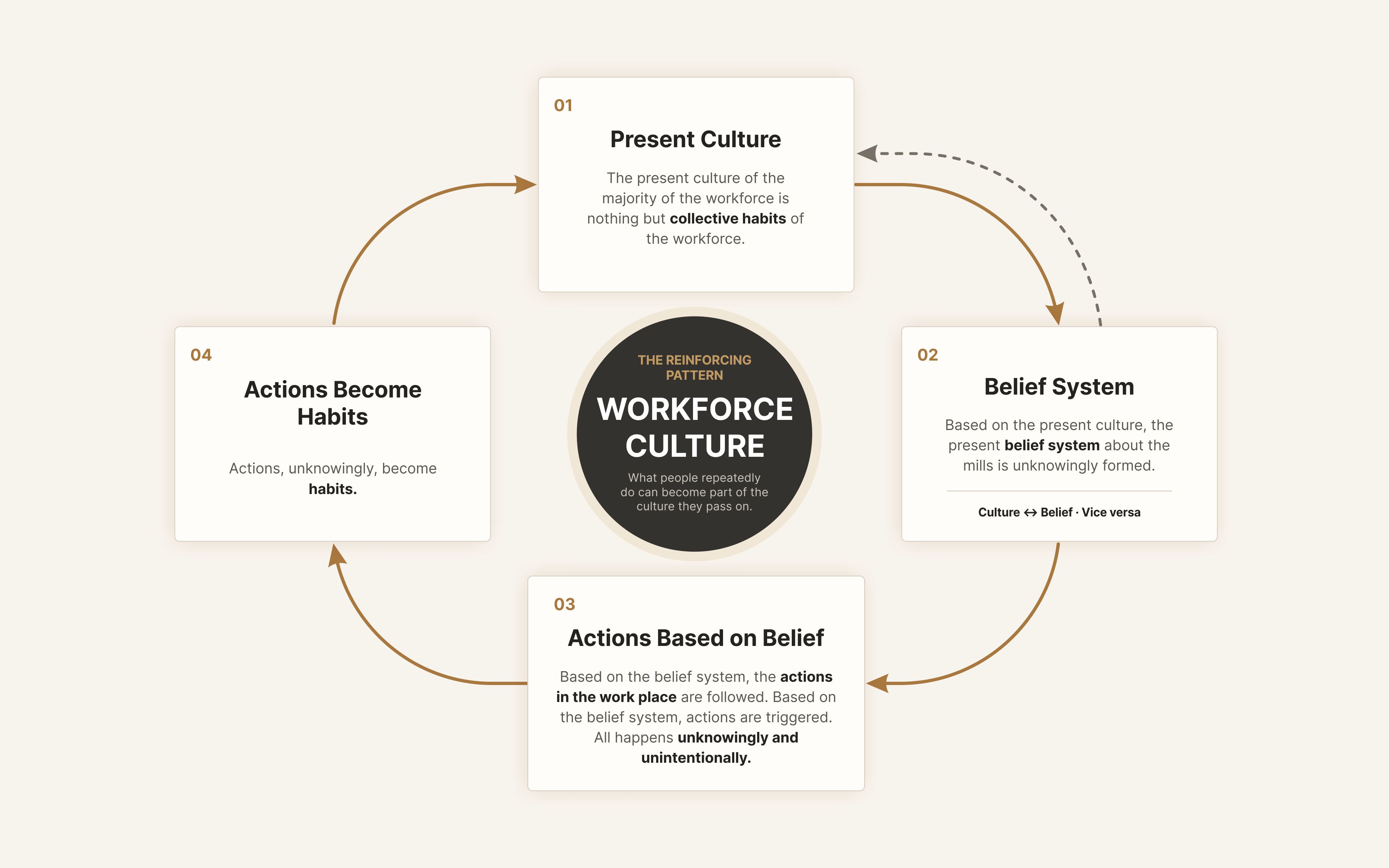
Over time, the collective habits of the workforce shape the existing culture. That culture influences the belief system people develop about their workplace. That belief system influences how people act. And repeated actions gradually become habits.
WORKFORCE
CULTURE
Changing the workforce without changing the system may simply reproduce the same pattern.
Some textile mills continue to achieve strong productivity, consistent quality, and excellent overall performance even in a challenging environment.
Their workforce can be more energetic, positive, engaged, and connected with their work.
One important factor is the environment in which people work and the belief system and habits that develop within it.
Recruit
Train
Expect Improvement
See the Same Problems Return
When a new employee joins a mill, that person does not enter an empty system.
They enter an existing culture. They observe it. They experience it. They gradually become part of it.
If the existing belief system and habits are not supporting the outcomes the mill wants, the new workforce can become part of the same pattern.
Culture shapes belief. Belief shapes action. Action becomes habit. Habits reinforce culture.
The cycle helps explain why an existing workforce culture can continue to reproduce itself. The relationship between culture and belief works both ways, while everyday actions based on belief gradually become habits.
It is often not a lack of people. It is a lack of realization.
People may perform according to established practices without fully understanding how those practices influence productivity, quality, waste, and other aspects of mill performance.
The SWCP creates a structured environment where employees are encouraged to discuss their work, examine the practices within their control, identify hidden opportunities, understand their impact, and find ways to improve.
Instead of every improvement being simply instructed by a superior, the program creates opportunities for discussion, realization, peer review, and willingness to adopt better practices.
The program follows a clear direction.
The objective is not to impose a new culture from outside. It is to create the conditions in which the workforce can understand, participate, learn, discuss, and gradually develop better ways of working.
Make people realize.
Change the present belief system.
Enable new and better actions.
Form new and better habits.
Allow those habits to influence culture.
Create a new Smart Workforce culture.
Prime Group → Sub-groups → Individual Operator
The program creates a structured pathway for value creation to reach progressively across the workforce.
ASPECT
WITHIN CONTROL
The program begins with a Prime Group of employees.
The purpose of this group is to focus on finding opportunities for value creation in all aspects within their control, extending through sub-groups and ultimately reaching the individual operator level.
First, the Prime Group is trained in all aspects of the program. Then, under the guidance of each person in the Prime Group, sub-groups are formed, creating a structured pathway through which the program reaches progressively across the workforce.
The major role of the Prime Group, through the sub-groups and down to the individual employee, is to focus on value creation in each aspect within their control limits.
They observe.
They identify opportunities.
They understand the impact of practices.
They review one another's work.
And they begin to recognize opportunities that may previously have remained within the hidden potential zone.
Instead of every improvement being simply instructed by a superior, the program creates opportunities for discussion, realization, peer review, and willingness to adopt better practices.
This Is Not Another Training Program.
The Smart Workforce Community Program is designed to influence how people think, act, learn, and work together.
Its focus extends beyond transferring knowledge.
It is about creating realization.
It is about encouraging participation.
It is about developing better habits.
It is about creating a workforce culture that continuously looks for opportunities to create value.
Science translated into a practical workforce environment.
The program has been scientifically architected and designed by distilling insights from multiple fields and sources.
Neuroscience
Positive Psychology
Organizational Psychology
Behavioural Psychology
International Research
Research from Leading Business Schools
Insights from International Experts
The intention is to bring these insights into a practical program suited to the workforce environment of textile mills.
The program is designed to be results-oriented when implemented in the intended context, with GTS guiding the mill through each phase and providing subsequent support.
When everyday practices become connected to mill performance.
The opportunity extends beyond individual behaviour.
Value Creation
Productivity
Quality
Waste Levels
Workforce Engagement
Workforce Stability
Everyday Work Habits
The Culture of the Mill
A basic-level foundation program in the GTS portfolio.
The Smart Workforce Community Program is the basic-level foundation program in the GTS portfolio.
Its purpose is not to create a temporary improvement campaign.
It is to begin developing the conditions for a new Smart Workforce ecosystem where employees participate in identifying opportunities, understand the value created through their actions, and develop better habits through realization and collective learning.
A Smart Workforce culture begins when people start seeing their everyday work differently.
Every day, the culture is being shaped.
The question is not whether culture is being created. The question is: What culture is being created?
Every day, your workforce is learning something.
Every day, practices are being repeated.
Every day, habits are being reinforced.
If your mill is experiencing recurring workforce challenges despite continuous effort, the opportunity may lie deeper than another training intervention.
It may be time to examine the belief system, habits, participation, and culture that shape everyday behaviour.
Build the foundation for a new Smart Workforce ecosystem.
If this reflects the reality within your mill, the first step is not to assume what the solution should be. It is to understand the existing system.
GTS can work with the mill to understand its context, establish the appropriate Prime Group structure, guide each phase of the program, and provide subsequent support.
